
The Conversation Can No Longer Wait
Across Africa’s boardrooms, government offices, banking halls, and training centres, a quiet but powerful shift is underway. Artificial Intelligence is no longer a distant concept reserved for Silicon Valley or science fiction. It is here, reshaping how decisions are made, how services are delivered, and how organizations compete.
The question is no longer whether AI will transform work in Africa; it already is. The real question is whether Africa’s workforce is prepared to lead that transformation, or be left behind by it.
At Predictive Analytics Lab, we have had the privilege of working across industries and borders. From financial institutions, to NGOs, government agencies, and corporates across the continent. What we observe on the ground tells a clear and urgent story: the gap between where AI is heading and where most African organizations currently stand is widening. And the window to close that gap is narrowing.
The Scale of What Is Happening
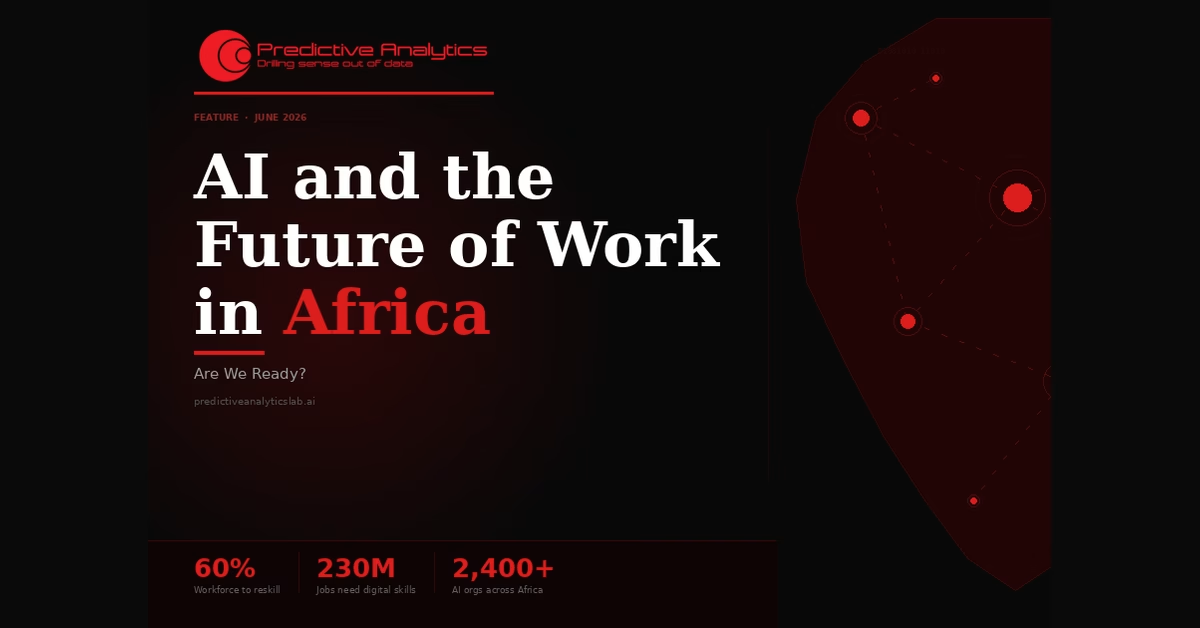
The numbers are sobering. According to the World Economic Forum, roughly 60% of Africa’s workforce will need reskilling in the coming years as technology reshapes industries and business models. A further projection from the International Finance Corporation estimates that by 2030, 230 million jobs across Sub-Saharan Africa will require digital skills. At the same time, AI and information processing trends are expected to displace millions of jobs globally while creating millions of new ones, but only for those equipped to fill them.
Yet there is a compelling opportunity hidden within these statistics. Africa’s young population is projected to grow by 450 million by 2035. If education systems, training institutions, and employers can equip this generation with digital, analytical, and AI relevant skills, the continent’s demographic advantage becomes its greatest competitive asset. AI, used well, could add up to 3% economic growth for Africa, but only if the continent invests deliberately in infrastructure, skills, and solutions designed for African contexts.
The opportunity is real. So is the risk of inaction.
What Is AI Doing to Work?
To prepare, organizations first need to understand what AI is actually doing to the world of work, not in abstract terms, but practically.
It is not simply about eliminating jobs. It is reshaping them.
Global research from PwC’s 2026 AI Jobs Barometer, analyzing over a billion job advertisements across six continents, finds that companies most exposed to AI are actually growing their headcount faster, raising wages faster, and achieving productivity gains 40% higher than companies least exposed to AI. Far from being a job killer, AI, when deployed strategically, is proving to be a job expander and a value amplifier.
What AI is doing, however, is raising the bar for what every role requires. Skills needed for AI-exposed jobs are changing more than twice as fast as for non-exposed roles. Junior employees in AI-exposed roles are seven times more likely to be expected to demonstrate leadership-level skills. The workforce of tomorrow will need to think more critically, communicate more clearly, lead more confidently, and collaborate more effectively with both humans and machines.
The threat is not AI. The threat is unpreparedness.
As most experts put it plainly, AI will not replace people, but people who do not learn how to use AI may find themselves replaced by those who do.
Africa’s Unique Context
It would be a mistake to import the Western conversation about AI and work wholesale into the African context. Africa’s reality is different, and that difference matters.A significant portion of Africa’s workforce is employed in agriculture and the informal sector, areas where AI’s immediate disruption is likely to be delayed compared to formal, digitized industries. This gives the continent a narrow but valuable window to prepare deliberately rather than reactively.
At the same time, Africa already has more than 2,400 AI-focused organizations, reflecting a growing innovation base. Countries like Kenya, Nigeria, South Africa, Egypt, and Rwanda are emerging as continental hubs for technology and digital innovation. The foundations exist. What is needed now is a scaling of ambition and of investment in people.
There is also a cultural and structural reality that organizations must grapple with: the biggest barrier to digital transformation in Africa is not the technology, it is skills. Training systems have historically struggled to keep pace with technological change. Courses become outdated. Training is treated as a once-off event rather than a continuous investment. And too often, capacity-building programmes are disconnected from the strategic realities of the organizations they serve.
This is precisely what we have observed and worked to address at Predictive Analytics Lab. Effective AI readiness is not about a single workshop. It is about embedding a culture of learning, curiosity, and adaptability at every level of an organization.
The Sectors That Must Move Now
Based on our work across the continent, certain sectors face particularly urgent transformation pressures:
Financial Services and Banking
Banks, microfinance institutions, and fintechs are already deploying AI for credit scoring, fraud detection, customer service, and risk management. Institutions that train their people to understand, interpret, and work alongside these systems will outperform those that deploy the technology without the accompanying human capability. We have seen this firsthand in our training work with financial institutions across the continent. The organizations that invest in people alongside technology are the ones achieving real, measurable results.
Government and Public Sector
AI is entering legislative and public service environments. From data-driven policy making to administrative automation. Government leaders need enough AI literacy to make sound decisions about technology adoption, data governance, and citizen impact. We have had the opportunity to train staff from the legislative branch on AI in the Legislature, and the appetite for practical, relevant knowledge was enormous.
NGOs and Development Organizations
International development organizations operating in Africa are under growing pressure to demonstrate impact through data. AI and analytics tools can transform how programmes are monitored, evaluated, and scaled, but only if staff are equipped to use them meaningfully.
Healthcare and Education
These are sectors where AI holds extraordinary promise for a continent with acute resource constraints. AI-assisted diagnostics, personalized learning, and predictive health monitoring could accelerate access and equity. But deploying these solutions responsibly requires a workforce that understands both the technology and its ethical implications.
What Organizations Must Do Now
The organizations that will thrive in Africa’s AI-enabled economy are not necessarily the ones with the most sophisticated technology. They are the ones that most effectively combine technology with human capability. Here is what that requires:
1. Treat AI literacy as a leadership imperative, not an IT matter. AI decisions (what data to collect, what to automate, what to leave to human judgment) are strategic decisions. Every leader, regardless of technical background, needs sufficient AI literacy to participate meaningfully in those decisions. Executive AI training is no longer optional.
2. Invest in continuous, practical learning and not one-off training. The half-life of skills is shrinking rapidly. Organizations need learning ecosystems, not training events. This means structured reskilling programmes, learning pathways tailored to different roles, and a culture that rewards curiosity and growth.
3. Build African-centric AI solutions and capabilities. Africa’s AI future should be shaped by African contexts, African data, and African expertise. Organizations that develop internal analytics talent i.e., people who understand both the technology and the local environment, will be far better positioned than those that rely entirely on imported solutions.
4. Address data governance before scaling AI. AI is only as good as the data it is built on. Organizations that invest in data quality, data strategy, and data governance now are laying the foundation for AI adoption that is reliable, ethical, and legally compliant. In Kenya, the Data Protection Act of 2019 sets a clear framework that organizations must be equipped to operate within it.
5. Partner with specialist organizations that bridge strategy and execution. Building AI capability from scratch is neither practical nor necessary. Partnering with organizations that have deep expertise in analytics, training, and consulting enables faster, more effective transformation, with less risk.
Our Perspective from the Ground
At Predictive Analytics Lab, we have been building Africa’s AI and data science capability since 2017. From our base in Kenya, with operations in Tanzania and the United Kingdom, we have worked with banks, government institutions, insurance companies, oil and gas companies, the hospitality industry, manufacturing companies, retail companies, international NGOs, corporates, and development finance organizations to deliver training, analytics solutions, and data strategy that drive real outcomes.
What we know with certainty, after nearly a decade of this work, is this: the organizations that invest in their people’s ability to understand and work with data and AI are the ones that transform. Not slowly, and not painlessly, but decisively.
Africa has everything it needs to be a leader in the AI era: a young, growing population, an expanding innovation ecosystem, and an intimate understanding of the complex, real-world problems that AI can help solve. What Africa needs now is the will at the level of governments, organizations, and individuals to invest in the human capability that makes AI meaningful.
The future of work in Africa will not be shaped by algorithms alone. It will be shaped by the Africans who learn to use them.
About Predictive Analytics Lab
Predictive Analytics Lab is a leading Big Data and analytics firm founded in Kenya in 2017, with expansions to Tanzania in 2023 and the United Kingdom in 2024. We are a certified data processor specializing in training, software development, and data strategy consulting. Our NITA-certified training programmes span technical, professional, and executive domains, including Agentic AI, Advanced AI, and Machine Learning courses designed for both technical and non-technical leaders. We help organizations across Africa and beyond harness the power of data to drive strategic decisions and operational excellence.
To learn more about our training programmes, AI and software solutions, data analytics, and consulting services, visit us at
Kenya Office
The Westery | Suite 2C, 2nd Floor| Mpesi Lane – Off Muthithi Road| Westlands , Nairobi
Phone +254725349693 /+254768095500