The HR Manager Who Missed the Warning: Why Knowing an Employee Will Quit Isn’t Enough Anymore!

The alert came three weeks before she resigned.
The system had picked up all the right signals. Her engagement scores had been declining for two months. She had a new manager she had barely met. And her name had quietly disappeared from the list of candidates being considered for the next promotion cycle.
The prediction was accurate. It reached the right inbox at the right time.
Her manager saw the alert. He meant to act on it, but a client escalation consumed the rest of his week. By the time he returned to it, the resignation letter was already on his desk.
This is not a story about bad HR technology. The prediction worked exactly as designed.
It is a story about what happens in the space between knowing something is likely to happen and doing something about it.
For HR teams across Kenya and the region, that gap is quietly becoming one of the most expensive problems in the employee lifecycle. We are getting better at predicting who might leave. The harder question is whether organisations are getting better at acting before they do.
The Part of HR Analytics Nobody Budgets For
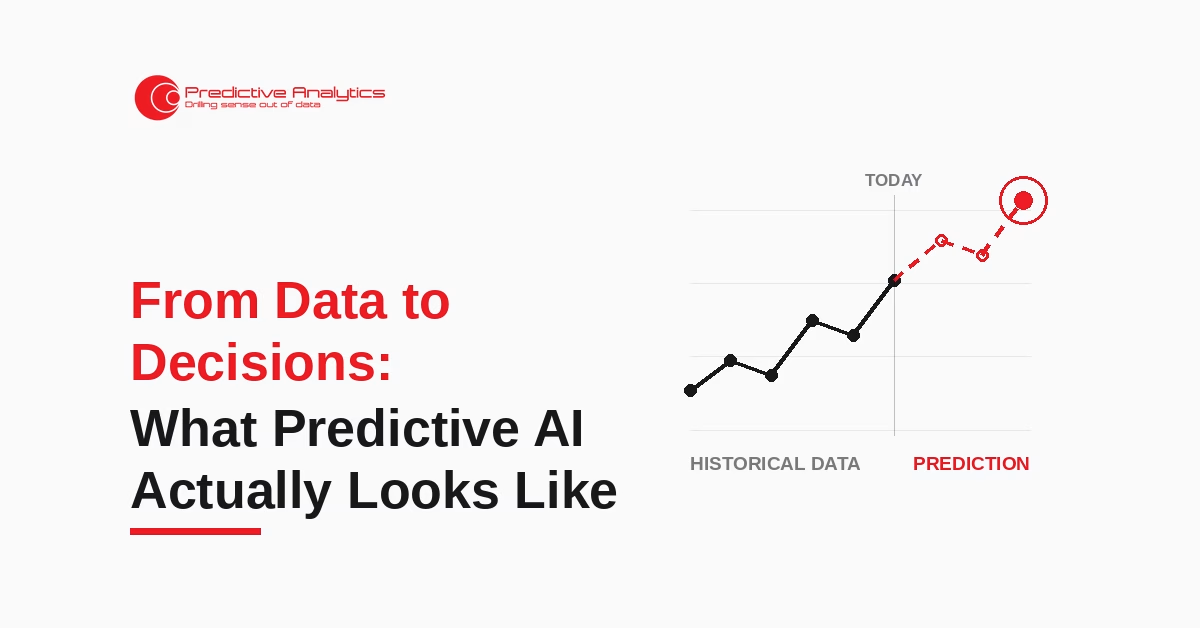
Most organizations that invest in HR analytics invest in the first half of the problem. They build dashboards that flag attrition risk, surface pay equity gaps, or predict which candidates are likely to succeed. These are genuinely useful tools, and getting them right already takes real work: clean HRIS data, a defined question, and people who trust the output enough to look at it.
But a flagged risk that nobody acts on in time is not meaningfully different from having no flag at all. The employee still leaves. The pay gap still widens for another review cycle. The candidate who was a strong fit still accepts an offer from a competitor who moved faster. The cost of the miss is not the absence of insight. It is the absence of a system built to make sure insight turns into action while there is still time to act.
What Closing the Gap Actually Looks Like in HR
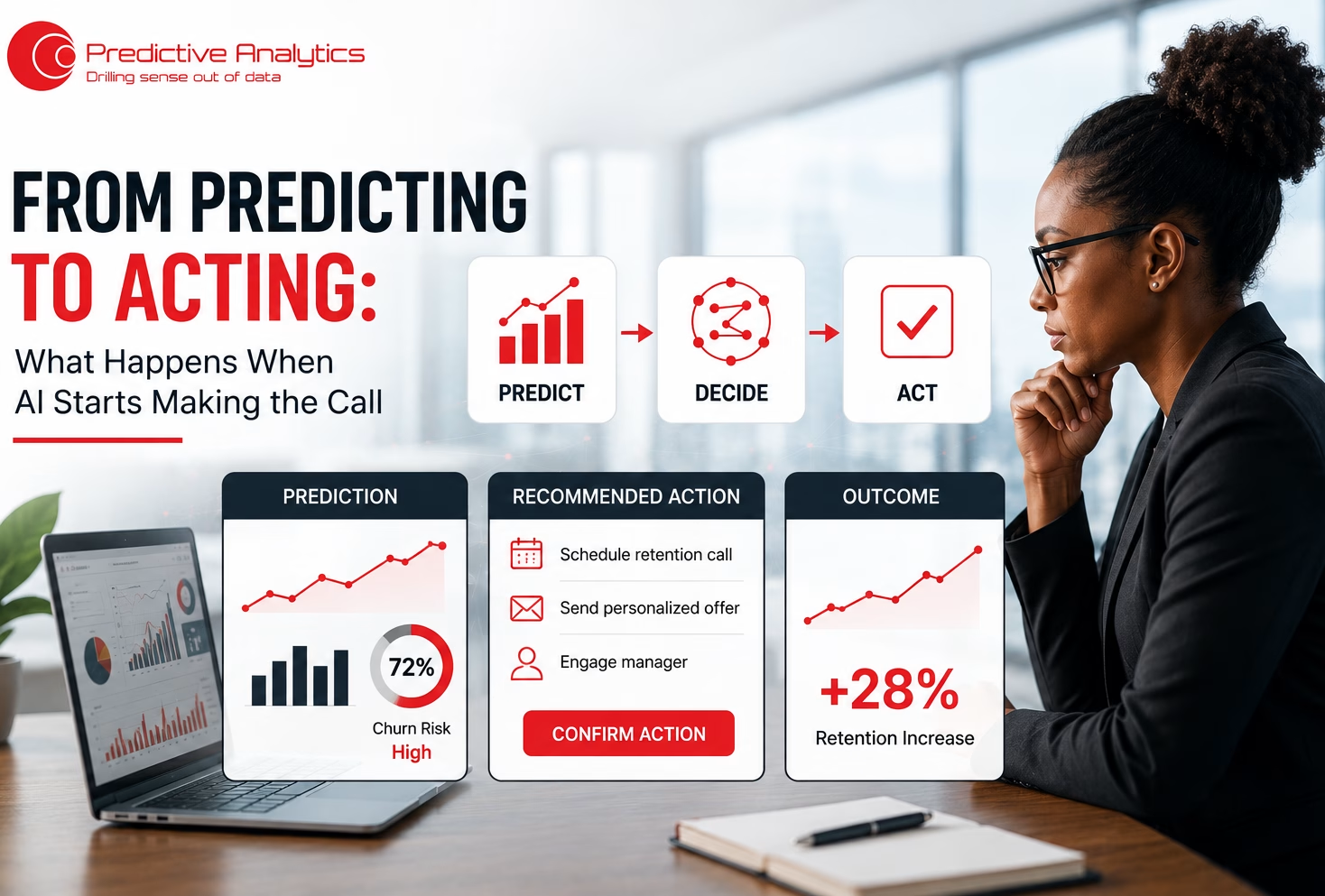
This is where a newer layer of HR technology, often called agentic AI, is starting to change what “HR analytics” means in practice. The shift is not about replacing the manager’s judgment. It is about making sure that judgment gets exercised at the moment it can still change the outcome. In practice, this looks like:
- A retention-risk system that does not stop at the alert, but drafts the retention conversation, finds a slot on the manager’s calendar, and follows up automatically if the conversation has not happened within a set number of days.
- A recruitment pipeline that flags when a shortlist is narrowing in a way that raises fairness questions, and routes it to a second reviewer before an offer goes out, rather than after someone raises a complaint.
- A leave and workload system that notices a pattern of burnout risk building in one team and prompts a scheduled check-in, instead of waiting for a resignation or a grievance to surface it.
None of this requires exotic technology. It requires the same clean, connected HR data that good analytics has always depended on, plus one deliberate organizational decision: which of these actions can be trusted to happen automatically, within limits HR leadership has explicitly set, and which must always wait for a person.
Why HR Cannot Treat This Like Every Other Department
Finance can bound an automated action by a monetary threshold. A collections system can send a payment reminder without much risk of getting it wrong in a way that damages anyone. HR does not have that luxury. An automated action in HR touches someone’s livelihood, their standing with a manager, or their chances at a promotion, and a wrongly triggered one does not stay contained to a spreadsheet. It becomes a conversation someone has to have, a decision someone has to defend, or a pattern someone eventually has to explain to a regulator or an aggrieved employee.
That is exactly why every HR team moving in this direction needs to be able to answer a short set of questions before automating any part of the employee lifecycle. What is the worst plausible outcome if this system acts on a wrong signal? Is that outcome reversible? Who in the HR team is accountable if it happens, and do they know it? And can someone intervene in real time, not just review the decision after the fact?
If any one of those questions does not have a confident answer, the action stays at the recommend-only stage, where a person still decides, until the organization is ready to answer it properly.
The Skill Gap Behind the Technology Gap
Here is what three years of training HR and people teams across the region has made clear: the barrier to doing this well is rarely the software. It is that very few HR professionals have been trained to read a predictive signal critically, to design the bounded, well-governed action that should follow it, or to know when a system has quietly begun making decisions it should not make unsupervised.
This is precisely the gap the HR Analytics programme at Predictive Analytics Lab is built to close. It is not a course about learning a tool. It is training built around the judgment this article has been describing: how to read attrition, performance, and workforce data with rigor, how to design HR processes where prediction reliably turns into timely action, and how to set the governance boundaries that keep automation in HR safe, fair, and defensible.
The HR manager in the opening story did not need a smarter alert. She needed a system, and a team, built to make sure the alert was never the last step. That capability is learnable, and it is exactly what the HR Analytics programme exists to build.
If your HR team is sitting on predictions it does not have a reliable way to act on, that is worth a conversation before the next resignation letter lands on someone’s desk.
Reach out, and let’s talk.