

Picture a mid-sized company in Nairobi. It runs a point of sale system that records every transaction, an HR system that tracks every employee, and a finance system that captures every shilling flowing in and out. Its sales team, however, still relies on WhatsApp and mobile money to close deals. On paper, this business is already drowning in data.
And yet, when the CEO asks a simple question, “Which of our branches is likely to miss its target next quarter?” no one can answer with confidence. One person opens three different spreadsheets, another starts digging through emails, and someone else promises, “We’ll share a report by Friday.” By the time the answer finally arrives, it is already a week too late to inform of any meaningful action.
This is the insight gap: the growing disconnect between the volume of data an organization collects and its ability to turn that data into timely, actionable decisions. It is one of the most common yet least visible challenges facing businesses across Kenya and the wider region today.
Most organizations are not short on information; they are short on the ability to use it when it matters most.
What the Insight Gap Actually Looks Like
The insight gap rarely announces itself. It hides inside routines that feel normal:
- A report that takes two weeks to produce, by which point the situation it describes has already changed.
- A dashboard that exists, but there is only one person who knows how to read and update it, only when they remember to.
- A leadership meeting where the loudest opinion in the room outweighs the data sitting untouched in the system next door.
- Three different departments are quoting three different numbers for what should be the same figure.
None of these looks like a crisis on any single day. That’s exactly why the gap is so easy to ignore and so expensive over the course of a year.
Why the Gap Forms: Three Root Causes
1. The data lives in silos.
HR data sits in one system, sales in another, and finance in a third, and none of them talk to each other. Getting a single, honest picture of the business means manually stitching together numbers from several sources, which is slow enough that most people simply stop trying. A retention risk visible in the HR system, for instance, rarely reaches the sales leader whose team is about to lose its top performer.
2. Reporting depends on a person, not a process.
In many organizations, “analytics” means one skilled but overworked employee who builds a report once a month by hand. It works until that person goes on leave, changes jobs, or simply runs out of hours in the day.
Insight that depends on one individual isn’t a system; it’s a single point of failure.
3. Data is collected, but rarely verified.
Systems log activity by default, but almost nobody goes back to ask: Is this data clean? Is it consistent across branches and time periods? Is it even measuring what we assume it measures? Bad or inconsistent data doesn’t just fail to help; it actively misleads, because decisions built on it feel evidence-based even when they aren’t.
The Real Cost of the Gap
The cost of the insight gap rarely shows up as one dramatic failure. It shows up as a pattern of smaller, quieter losses that compound over a year:
| Where it shows up | What it looks like |
| Talent | A strong performer resigns, and only afterward does anyone notice the warning signs like falling engagement and rising absenteeism that were already sitting in the HR system. |
| Revenue | A branch keeps missing the target, and leadership blames the sales team, when the real cause was a supply delay nobody was tracking. |
| Speed | A competitor reacts to a market shift in days; your organization is still waiting for next month’s report. |
| Trust | Different departments arrive at meetings with different numbers for the same metric, and decisions stall while people argue about whose figure is right. |
| Compliance | Inconsistent or poorly governed data becomes a liability the moment a regulator, auditor, or partner asks a hard question about it. |
Individually, each of these feels manageable. Together, across a full year, they represent a meaningful and largely avoidable drag on performance.
The Four Stages of Data Maturity
Closing the insight gap isn’t a single leap; it’s a progression. Most organizations sit somewhere on this ladder without having consciously mapped it:
- Stage 1: Aware. Data exists across various systems, but nobody has a full picture. Decisions are made mostly on instinct and experience.
- Stage 2: Collecting. Systems capture data reliably, but it stays in siloes. Reports are manual, slow, and usually reactive rather than proactive.
- Stage 3: Connected. Data from different systems feeds into a shared view i.e., a dashboard or a data warehouse. The single source of truth is that leadership can check without waiting on one person.
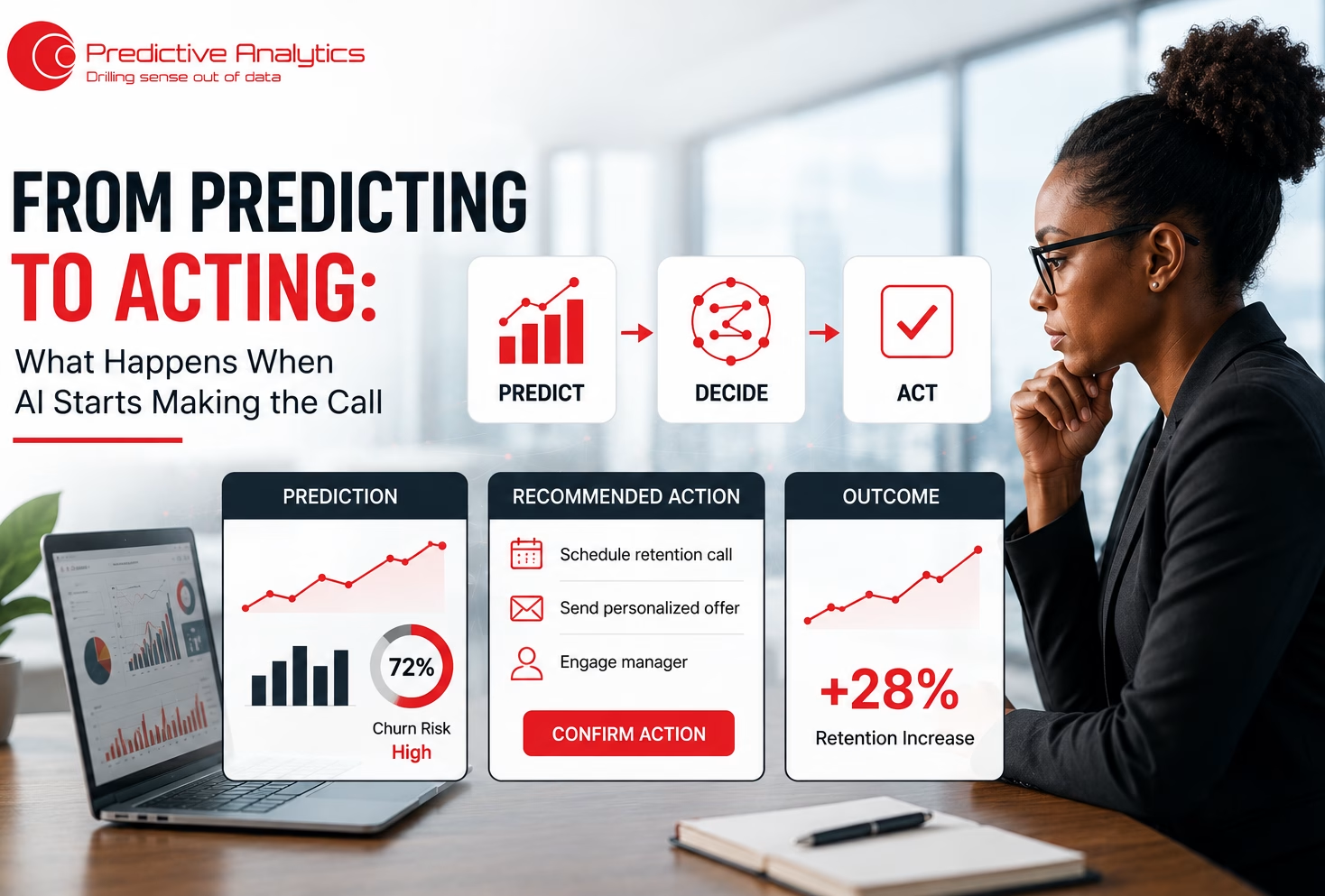
- Stage 4: Predictive. The organization doesn’t just look backward at what happened; it uses clean, connected data to anticipate what’s likely to happen next, which employees are flight risks, which customers are about to churn or which branch needs support before it misses target.
Most organizations in the region sit between Stage 1 and Stage 2. The jump to Stage 3 is where the insight gap genuinely starts to close, and it is far more achievable and far less expensive than most leaders assume.
Where AI Fits and Where It Doesn’t
This is also why so many AI initiatives across the continent quietly disappoint. AI is not magic; it is a very fast, very literal student of whatever data it is given. An organization still at Stage 1 or 2 will not get reliable AI predictions by simply adding a chatbot or a model on top; instead, it will get confident-sounding guesses produced faster than before.
Closing the insight gap is not a competing priority to AI adoption. It is the foundation that makes AI useful in the first place. The organizations that will gain real value from AI in the coming years will not be those with the flashiest tools, but those that have done the unglamorous work of connecting, cleaning, and structuring their data first.
A Quick Gut Check
Ask yourself honestly:
- Could your organization identify which employees are most at risk of leaving this quarter using data rather than intuition?
- If your best analyst went on leave tomorrow, would your reporting and decision-making processes continue without disruption?
- When was the last time your leadership team made a major strategic decision based on insights from a dashboard rather than relying on assumptions or incomplete information?
- If two departments were asked to report the same metric today, would they produce the same answer?
If any of those questions gave you pause, you’re not behind; you’re exactly where most organizations are. What separates the ones that pull ahead isn’t better data. It’s a better habit around the data they already have.
Three Habits That Close the Gap
You don’t need a data science team or expensive new software to start. You need three consistent habits:
- Collect it well. Ensure that the systems you already use capture clean, accurate, and consistent data from the outset. Most organizations do not have a data shortage. They have a data quality problem. Decisions can only be as reliable as the information upon which they are based.
- Connect it. You do not need to replace your existing technology with a single, monolithic platform. Instead, integrate your systems so they contribute to a unified source of truth. Whether through a well-designed dashboard or a centralized reporting platform, leadership should be able to see the complete picture in one place, rather than assembling it from multiple reports, systems, or browser tabs.
- Use it routinely. Insight only creates value when it becomes part of the decision-making process. Data reviewed once a quarter is often more of a historical record than a strategic asset. Establish a regular rhythm, whether weekly or monthly, where decisions are guided by timely, evidence-based insights rather than assumptions or intuition.
Closing the Gap
The insight gap is what separates organizations that simply collect data from those that use it to make decisions. Predictive Analytics Lab works with organizations around the world to close this gap through software, training, and strategy, enabling internal teams to move beyond raw data and develop the capability to generate and act on insight independently.
If the questions above left you without confident answers, that’s not a reason to worry. It’s simply the starting point for the conversation. Reach out, and let’s talk.
Visit us:
Kenya Office
The Westery | Suite 2C, 2nd Floor | Mpesi Lane – Off Muthithi Road | Westlands, Nairobi
Call us: +254 725 349 693 / +254 768 095 500
Email: sales@predictiveanalytics.co.ke
Web: www.predictiveanalyticslab.ai


Permalink