
Picture the same mid-sized company we met in The Insight Gap. It has done the hard, often unglamorous work. Its systems now communicate seamlessly, and its leadership can open a single dashboard to view sales, HR, and finance data in one trusted place. The insight gap has been closed.
Yet something is still missing!
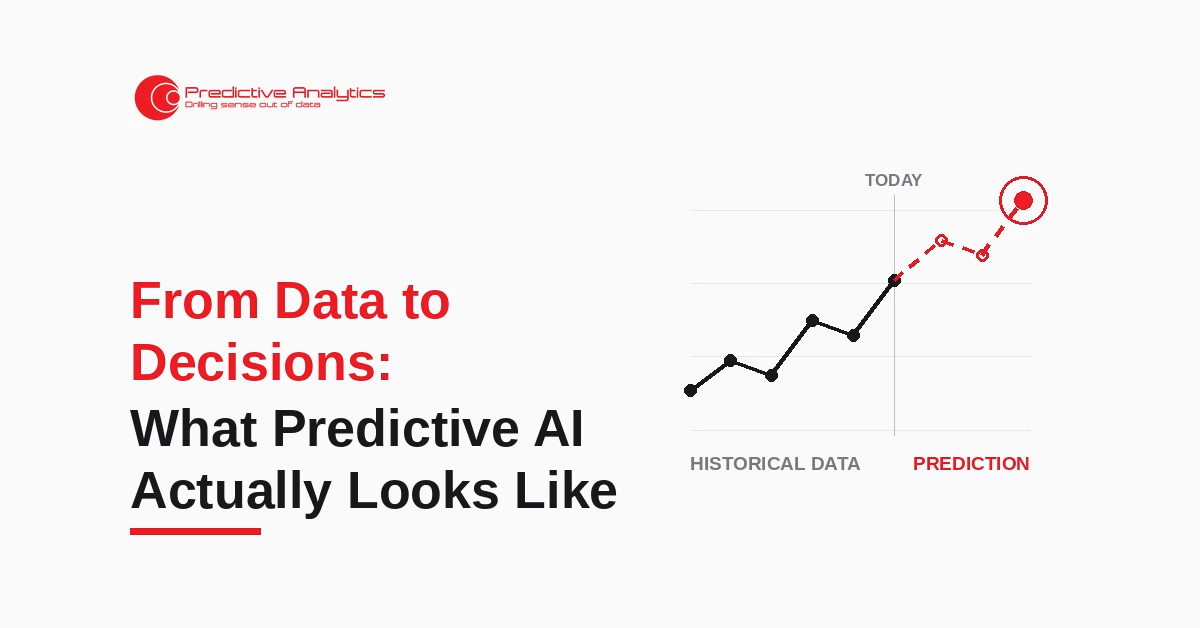
The dashboard tells the CEO what happened last month, but it cannot tell her what is likely to happen next month. She can see that three branches missed their targets, but she still cannot identify which branch is most likely to miss its target next.
This is the gap between Stage 3 and Stage 4 of data maturity, the shift from being connected to becoming predictive. It is where many organizations stop, not because the technology is out of reach, but because they have never been shown what predictive AI looks like when applied to ordinary, everyday business decisions.
Predictive AI is not about a model. It is about a question answered before it needs to be asked.
What “Predictive” Actually Means in Practice
Strip away the jargon, and predictive AI is surprisingly simple. It uses patterns in your existing data to estimate the likelihood of future outcomes, then presents those predictions to the people who make the decisions. AI informs the decision; it does not replace the decision-maker.
Across different parts of a business, it looks like this:
In HR, instead of discovering that an employee has resigned, the system identifies the risk weeks or even months earlier. It detects patterns such as declining engagement scores, a recent manager change, and falling performance ratings, signaling that the employee may be at risk of leaving long before a resignation letter is submitted.
In sales, instead of realizing that a branch has missed its quarterly target after the quarter has closed, the system detects early warning signs such as slowing sales, declining customer traffic, or supply chain disruptions. Managers are alerted while there is still time to intervene and improve performance.
In finance, instead of writing off a bad loan after a customer defaults, the system estimates the probability of default at the point of application by learning from patterns in thousands of previous lending decisions and repayment histories. This enables more informed lending decisions before the risk becomes a loss.
In customer service, instead of quietly losing a client, the system identifies early indicators such as declining product usage, delayed payments, and reduced engagement with support services. These patterns often signal an increased risk of customer churn, prompting the account manager to reach out before the relationship is lost.
Across every function, the principle is the same. Predictive AI does not tell an organization what will happen with certainty. It identifies what is most likely to happen based on historical patterns, giving people the opportunity to act earlier, make better decisions, and achieve better outcomes.
The Three Ingredients Predictive AI Actually Needs
Organizations often assume predictive AI requires exotic technology. In practice, it requires three much more ordinary things.
The first is history. Predictive models learn from patterns that have already played out. A bank cannot predict default risk without years of repayment records. A retailer cannot predict churn without a record of who left before and what they had in common. Without history, there is nothing for the model to learn from.
The second is a clearly defined question. “Help us with AI” is not a project. “Which of our loan applicants are most likely to default in the next twelve months?” is a project. Predictive AI succeeds or fails based on how precisely the question is framed before any modeling begins.
The third is a human in the loop. A prediction is not a decision. A model that flags a flight risk does not fire anyone; it hands a manager information they did not have before, and the manager decides what to do with it. Organizations that treat predictions as automatic verdicts, rather than early warnings for people to act on, tend to lose trust in the system fast.
A Word of Caution!
Predictive AI is powerful, but it is not neutral. A model trained on biased history will confidently repeat that bias, just faster. If a lending dataset reflects years of a certain group being underserved, a model built on it will often continue to underserve that group unless deliberately checked. Prediction without responsibility is simply the automation of old mistakes.
This is why governance belongs in the same conversation as prediction. Before scaling any predictive system, organizations should be able to answer a few honest questions: What is this model optimizing for? Who might be disadvantaged if it is wrong? Who is responsible when it is?
What This Looks Like Stage by Stage
| Maturity Stage | What Leadership Can Do |
| Stage 1: Aware | React to problems after they are visible |
| Stage 2: Collecting | Report on problems after the fact |
| Stage 3: Connected | See the full picture in one place, in real time |
| Stage 4: Predictive | Act before the problem fully materializes |
The distance between Stage 3 and Stage 4 is not primarily a technology gap. It is a habit gap: the discipline of asking “what is likely to happen next” rather than only “what happened.”
Getting Started Without Overreaching
Organizations do not need to predict everything at once. The most successful predictive AI initiatives we have seen start narrow: one clear question, one dataset with sufficient history, one measurable outcome. A single working prediction, employee flight risk, loan default, customer churn, that leadership trusts and acts on consistently, does more for an organization’s AI maturity than five ambitious models nobody uses.
Closing the Distance
Reaching Stage 4 is not about buying the most advanced AI tool in the market. It is about pairing clean, connected data with a well-defined business question and a team equipped to interpret and act on predictive insights responsibly.
Predictive AI creates value when it becomes part of how an organization thinks and makes decisions, and not when it becomes another technology initiative sitting on the sidelines. The goal is not simply to build models, but to help people make better decisions before challenges become problems.
At Predictive Analytics Lab, we work with organizations to take this next step deliberately: from identifying the right questions, preparing the data, and developing predictive models, to building the capability of the people who will use those insights.
If your dashboards can already tell you what happened last month, the next conversation worth having is what they could tell you about next month. That is where the journey from data to decisions begins. Reach out, and let’s talk.
Kenya Office
The Westery | Suite 2C, 2nd Floor | Mpesi Lane, Off Muthithi Road | Westlands, Nairobi
Call us: +254 725 349 693 / +254 768 095 500
Email: sales@predictiveanalytics.co.ke | Web: www.predictiveanalyticslab.ai