
A prediction alone has never saved a job, retained a customer, or prevented a bad loan. Its value lies not in the prediction itself, but in the action that follows. Yet this is exactly where many organizations, even those that have invested heavily in becoming data-driven and predictive, quietly fall short.
Consider an HR system that identifies, three weeks in advance, that one of the organization’s top performers is at risk of leaving. The warning is based on clear indicators: declining engagement scores, a recent change in manager, and fewer recorded achievements. The alert reaches the employee’s manager exactly when it should.
The manager sees the notification and fully intends to act, but an urgent client issue demands immediate attention. Days pass. By the following week, the employee has resigned.
The prediction was accurate, but the organization still lost the talent it was trying to retain.
This illustrates the critical gap between predicting and acting. A highly accurate prediction delivers little value if no one responds to it. In practical terms, an ignored prediction is no more useful than having no prediction at all.
Bridging this gap is the natural next step after Stage 4 of the data maturity journey introduced in The Insight Gap. Think of it as Stage 5. Instead of merely informing people about what is likely to happen, the system recommends the most appropriate next action or, within clearly defined boundaries, carries it out automatically. This is the realm of Agentic AI, where intelligent systems move beyond generating insights to helping ensure those insights lead to timely decisions and meaningful outcomes. It is also the next frontier for organizations that have already built strong predictive capabilities.
What “Agentic” Actually Means in Practice
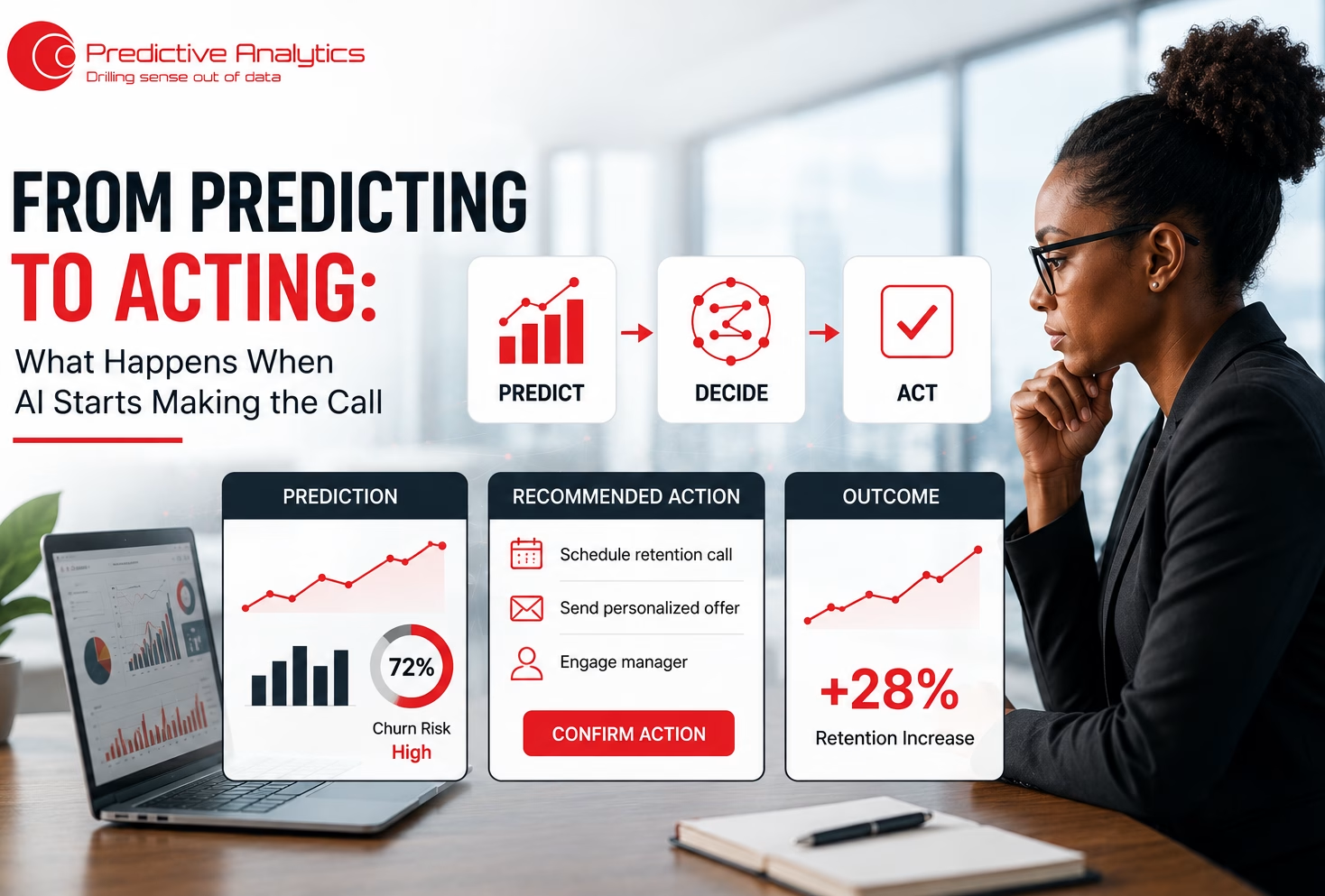
Strip away the buzzword, and Agentic AI differs from predictive AI in one important way: it closes the gap between insight and action. While predictive systems identify what is likely to happen, agentic systems help ensure the appropriate response happens at the right time. Rather than simply generating an alert, they recommend or, within carefully defined boundaries, execute the next best action.
Consider a few examples:
- Human Resources: Instead of merely identifying an employee at risk of leaving, the system drafts a retention conversation, schedules it on the manager’s calendar, and ensures timely follow-up to ensure the opportunity to intervene is not lost.
- Finance: Rather than only calculating the probability that a loan application may default, the system automatically routes high-risk applications above a predefined threshold to a second reviewer before approval.
- Customer Service: Instead of simply flagging customers showing signs of churn, the system immediately sends a pre-approved retention offer within established business rules, without waiting for an account manager to notice the alert.
- Sales: Rather than reporting that a branch is likely to miss its targets, the system automatically reallocates part of the approved marketing budget to that branch within limits already authorized by leadership.
None of these examples require futuristic technology. They build on the same foundation that predictive AI already depends on: clean, connected, and reliable data. The additional step is organizational rather than technical.
Leaders must decide which actions can safely be delegated to AI and which should always remain under human oversight.
It is also important to be realistic about where many organizations in Kenya and across East Africa currently stand. Fully autonomous AI systems remain rare, and there is no reason for organizations to feel they are falling behind. Many are still strengthening the data foundations required for predictive analytics before they can confidently move toward greater automation.
What is emerging today is a more practical and measured approach. Banks, insurance companies, and telecommunications firms are beginning to deploy narrowly scoped agentic systems that automate low-risk, high-volume decisions. A fraud detection system may temporarily hold a suspicious transaction pending review. A claims platform may automatically fast-track straightforward, low-risk claims. A collections system may send an initial payment reminder without waiting for a collections officer to intervene.
These are not fully autonomous organizations, nor do they need to be. They represent the first, carefully controlled steps toward Agentic AI. By limiting automation to well-defined, low-risk scenarios, organizations gain confidence in the technology while maintaining appropriate governance and human oversight. For most organizations, this is not only the most practical starting point but also the wisest one.
What Agentic AI Needs That Predictive AI Did Not
From Data to Decisions sets out three ingredients predictive AI needs: history, a clearly defined question, and a human in the loop. Agentic AI needs all three, plus two more, because the system is no longer just informing a decision. It is participating in one.
- Bounded scope. A predictive model can be wrong in a spreadsheet with no consequence beyond a person disregarding it. An agentic system’s scope must be defined narrowly enough that even its worst-case error is one the organization can absorb, an offer of the wrong size, not an approval that should never have happened.
- A visible audit trail. Every action a system takes on its own needs a record of what it did, on what basis, and when, that a person can review after the fact without needing to reconstruct it from logs scattered across systems. Without this, nobody can answer “why did it do that” when it matters most.
Skipping either of these does not make an agentic project fail quietly, the way a poorly scoped predictive model does. It tends to fail loudly, in the form of a customer complaint, a regulatory question, or a decision nobody can explain after the fact.
The Spectrum of Autonomy
Agentic AI is not one thing that an organization either has or does not have. It is a spectrum, and most organizations should sit somewhere in the middle of it, not at either end.
At one end, a system recommends only: it surfaces the prediction and a suggested next step, and a person decides whether to act at all. One step further, a system recommends with one-click approval: it prepares the action in full, a message, an approval, a reallocation, but a person must still confirm before it goes out. Further still, a system acts within pre-set bounds: it executes automatically inside limits the organization has explicitly approved, then reports afterward on what it did. At the far end, a system acts fully autonomously, executing without a pre-approval step or a bounded limit at all. This last level is rare, and rarely wise, outside narrow, low-stakes, high-volume tasks.
Most organizations that are ready to move past pure prediction belong in the second or third level. The fourth is rarely the right starting point, and for many decisions, it is never the right ending point either.
Why This Is Where Trust Is Won or Lost
A wrong prediction produces a bad alert. Someone reads it, checks it against what they know, and discards it if it does not hold up. The cost of being wrong is a few minutes of a person’s attention.
A wrong action, taken automatically, is a decision that has already happened. A loan declined on a flawed signal. A customer contacted with the wrong offer at the wrong moment. A shift understaffed because a reallocation model misread a pattern. The cost of error compounds the moment the pause between prediction and action is removed.
This is why the governance question raised in the previous article- what is this model optimizing for, who is disadvantaged if it is wrong, who is responsible when it is- becomes more urgent, not less, once a system starts acting rather than only advising. Autonomy does not remove the need for oversight. It changes where the oversight has to sit: before the action, in the form of clear bounds, rather than after it, in the form of a person reviewing an alert.
Consider a lending platform that automatically approves small loans below a threshold, built on a model trained mostly on urban, salaried applicants. It works well for months. Then it starts quietly declining a disproportionate share of informal-sector applicants whose income patterns simply look different in the data, not riskier, just different. Nobody notices for a while, because each decline looks defensible on its own. The pattern only becomes visible when someone finally asks for the aggregate numbers. By then, the organization has made hundreds of decisions it cannot easily explain and would not make the same way twice.
This is not a hypothetical unique to lending. The same shape of failure shows up wherever a bounded action runs unmonitored for long enough: a retention offer that consistently skips a customer segment, a scheduling system that quietly overloads one branch. The fix is rarely to abandon the automation. It is to have set the audit trail up before the system ran, not after someone complained.
Four Questions Before Handing Over Any Action
Before any system is allowed to act rather than only recommend, an organization should be able to answer these honestly:
- What is the worst plausible outcome if this system acts incorrectly?
- Is that outcome reversible, or final the moment it happens?
- Who is accountable when it gets it wrong, and is that person aware they hold that responsibility?
- Can a human step in and override the system in real time, not just review it afterward?
If any of these questions does not have a confident answer, the action in question belongs at the recommend-only or one-click-approval level described above, until it does.
Autonomy Is Earned, Not Defaulted To.
Put the pieces together, and the path is a narrow one, not a leap. Start with clean, connected data. Build a predictive model narrow enough that leadership trusts it consistently. Identify the smallest, most reversible action that model’s output could trigger. Bound it tightly, log everything it does, and only then let it run without a person in the loop for that one narrow case. Widen the scope from there, one bounded action at a time, never all at once.
The organizations ready to consider handing any decision to a system are, without exception, the ones that have already spent time trusting that system’s predictions and finding them reliable.
Agentic AI is not a shortcut past the predictive stage. It is what becomes possible only after that stage has been done properly.
Getting there is rarely a single step. It usually means training the people who will supervise these systems, so they know when to trust an automated action and when to pull it back. It means the strategy and governance work of a consulting engagement, so the bounds an autonomous system operates within are deliberately set before anything is switched on. And it means building the machine learning software itself, calibrated to act only within limits the organization has explicitly approved, and to report back clearly on what it did and why.
Predictive Analytics Lab works with organizations across each of these stages, training the people, advising on the strategy and governance, and building the software, so that the move from prediction to action is deliberate rather than accidental. If your organization is asking what it would take to let AI act on its own predictions, that is a conversation worth having before the technology forces it.
Reach out, and let’s talk.
Kenya Office
The Westery | Suite 2C, 2nd Floor | Mpesi Lane – Off Muthithi Road | Westlands, Nairobi
Call us: +254 725 349 693 / +254 768 095 500
Email: sales@predictiveanalytics.co.ke
Web: www.predictiveanalyticslab.ai